
KIU LMS 2026 | Student Guide
Deprecated: strip_tags(): Passing null to parameter #1 ($string) of type string is deprecated in /home/u287896820/domains/apkscrolls.com/public_html/wp-content/themes/appyn-3.16/functions.php on line 632
Deprecated: strip_tags(): Passing null to parameter #1 ($string) of type string is deprecated in /home/u287896820/domains/apkscrolls.com/public_html/wp-content/themes/appyn-3.16/functions.php on line 640
Deprecated: strip_tags(): Passing null to parameter #1 ($string) of type string is deprecated in /home/u287896820/domains/apkscrolls.com/public_html/wp-content/themes/appyn-3.16/functions.php on line 644
Deprecated: strip_tags(): Passing null to parameter #1 ($string) of type string is deprecated in /home/u287896820/domains/apkscrolls.com/public_html/wp-content/themes/appyn-3.16/functions.php on line 636
Deprecated: strip_tags(): Passing null to parameter #1 ($string) of type string is deprecated in /home/u287896820/domains/apkscrolls.com/public_html/wp-content/themes/appyn-3.16/functions.php on line 632
Deprecated: strip_tags(): Passing null to parameter #1 ($string) of type string is deprecated in /home/u287896820/domains/apkscrolls.com/public_html/wp-content/themes/appyn-3.16/functions.php on line 648
Description
Introduction
If you’re a student at Karakoram International University, you’ve probably already heard about the KIU LMS 2026 | Student Guide— the university’s online learning system. It’s the platform that brings your lectures, assignments, quizzes, grades, and announcements together in one place, so you don’t have to chase down information from five different sources.
Whether you just got admitted or you’re already a few semesters in, knowing your way around the LMS makes a real difference. You can pull up course material, catch a recorded lecture, or check a deadline from your phone at 11pm instead of waiting to ask someone on campus. It also means less back-and-forth with instructors — announcements, feedback, and grades show up directly on the platform instead of getting lost in conversation.
This guide walks through everything: logging in, finding your way around the dashboard, submitting assignments, joining online classes, downloading materials, checking your results, and fixing the login problems that inevitably come up at some point.
What Exactly Is KIU LMS 2026 | Student Guide?
It’s the official Learning Management System built for Karakoram International University — basically a digital classroom where students, instructors, and admin staff all interact. Instead of everything happening face-to-face, a good chunk of academic life moves online: lectures, assignments, quizzes, grades, and messages with instructors all live on the platform.
It works for both regular, on-campus programs and distance learning, which matters a lot given how spread out students are across Gilgit-Baltistan and the rest of Pakistan.
Why the University Built KIU LMS 2026 | Student Guide
The point isn’t just to have a website — it’s to make education more accessible and less bureaucratic. In practice, that means:
- Course material available any time, not just during class hours
- Support for online and hybrid learning
- Assignments submitted digitally instead of on paper
- Quizzes and exams that can be taken online
- Faster, clearer communication between students and faculty
- One place to keep academic records instead of scattered files
- More room for students to study at their own pace
It also cuts down on paperwork and gives instructors an easier time managing several courses at once.
Who Actually Gets Access
Access isn’t public — it’s for verified members of the KIU community, including:
- Undergraduate students
- Graduate students
- MPhil students
- PhD scholars
- Faculty members and course instructors
- Department coordinators
- University administrators
You’ll get your login details once you’re admitted and registered for courses. Hold onto them carefully — they’re tied to your academic record for the whole degree.
What the LMS Actually Lets You Do
Online Classes
This is probably the feature students rely on most. Through the LMS you can join:
- Live lectures
- Virtual classrooms
- Discussions
- Online workshops
- Recorded sessions
Instructors often upload recordings after class, so if you miss a live session — or just want to rewatch a confusing part — it’s there. This matters especially for students who live far from campus and can’t always make the trip in.
Submitting Assignments
No more printing pages or standing in line to hand something in. On the KIU LMS 2026 | Student Registration 2026, you can:
- Upload your work directly
- Submit before the deadline
- Get a confirmation that it went through
- Read instructor feedback
- Download your graded submission
The timestamp on each submission also protects you — there’s a clear record of exactly when you turned something in.
Course Materials
Every course has its own section where instructors post whatever students need:
- Lecture slides
- PDF notes
- Research papers
- Assigned readings
- Practice questions
- Reference books
- Lab manuals
It’s all in one place instead of scattered across emails and handouts.
Quizzes and Exams
The LMS handles online assessments too, including:
- Multiple-choice questions
- Short-answer questions
- Essay-style assessments
- Timed quizzes
- Midterms
- Finals
For objective questions, grading is often automatic, so you get your score right away instead of waiting days.
Announcements
Faculty post updates about things like class schedules, assignment deadlines, exam dates, holidays, events, and department meetings. It’s worth getting into the habit of checking this section often — it’s easy to miss something important if you only log in once a week.
Attendance
A lot of instructors track attendance for online sessions right through the LMS. This helps with monitoring participation, flagging attendance shortages early, and keeping an official record on file.
Results
You can check your assignment scores, quiz results, midterm marks, and final grades all in one place, which makes it much easier to track how you’re doing across the semester instead of waiting for a final report card.
Logging Into KIU LMS 2026 | Student Guide
What You’ll Need TO KIU LMS 2026
Before you try to log in, make sure you have:
- A registered KIU student account
- Your username or registration number
- Your password
- A stable internet connection
- An updated browser
Don’t share your login details with anyone — it’s your academic record on the line.
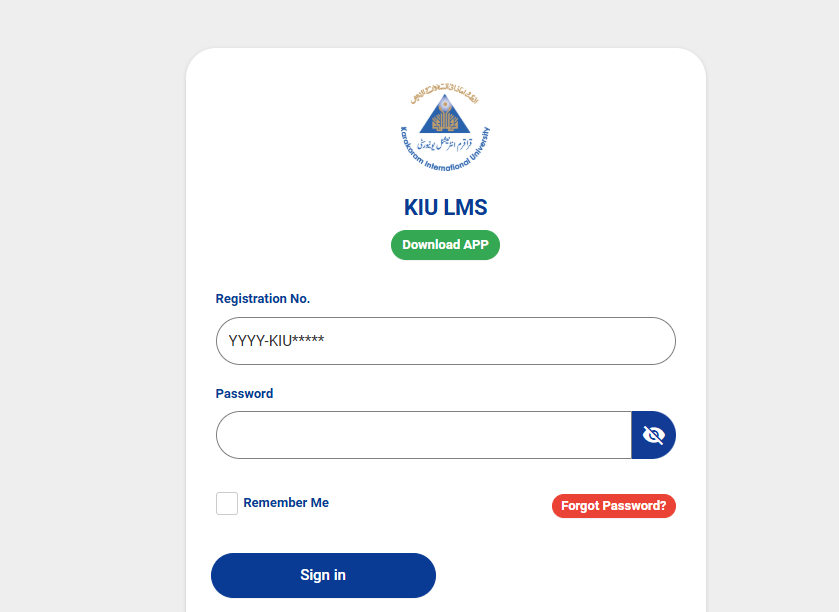
The Login Steps KIU LMS 2026
- Open your browser.
- Go to the official KIU LMS login page.
- Enter your username or registration number.
- Type your password.
- Click Login.
- Give it a moment to load your dashboard.
Once you’re in, you’ll have access to your courses, assignments, grades, announcements, and materials. If you’re using a shared or public computer, log out when you’re done — don’t just close the tab.
Forgot Your Password KIU LMS 2026 | Student Guide?
It happens. Here’s what to do:
- Look for a “Forgot Password” option on the login page.
- Enter your registered email or student ID.
- Follow the reset instructions you receive.
- Set a new password — make it strong, with a mix of letters, numbers, and symbols.
If there’s no self-service reset option, reach out to KIU IT Support, your department coordinator, or the LMS administrator directly.
Getting to Know the Dashboard
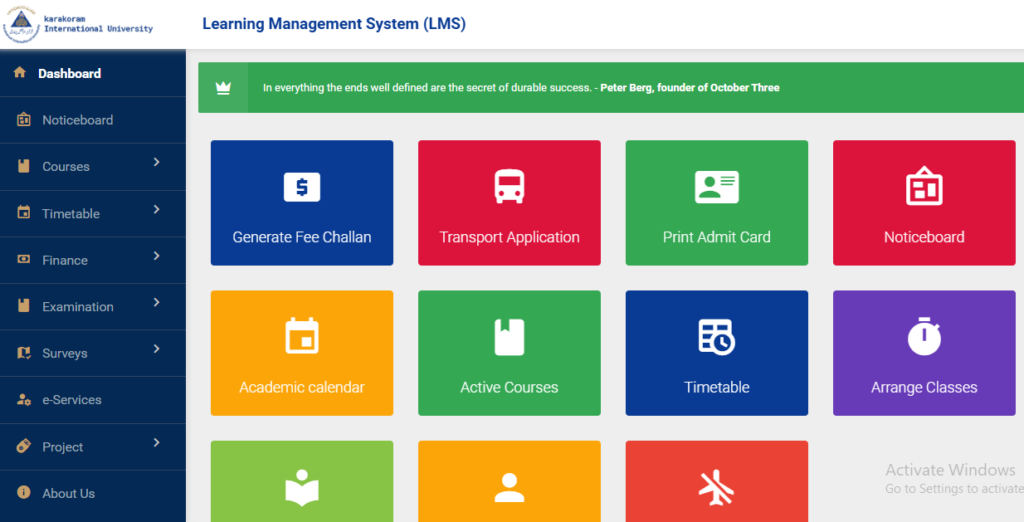
Once you log in, you land on the dashboard — this is your home base for everything academic. Here’s what each section does.
My Courses — Shows every course you’re currently enrolled in. Click into any of them and you’ll typically find the course outline, weekly modules, lecture notes, assignments, discussion forums, quizzes, and recorded lectures. Worth checking regularly so nothing sneaks up on you.
Notifications — Real-time alerts for anything that needs your attention: new assignments, quiz windows opening, approaching deadlines, feedback from instructors, grade updates, new announcements, and replies in discussions. Turn these on if you can — it’s the easiest way to stay on top of things without manually checking every section.
Calendar — A built-in schedule showing assignment deadlines, quiz and exam dates, class timings, university events, and holidays. Using this properly is honestly one of the simplest ways to avoid missing a deadline.
Profile — Where you manage your personal details: update your photo, change your password, update contact info, see your enrolled courses, and adjust account preferences. Keep this current — it’s how instructors and the university reach you.
Grades — A full breakdown of your academic performance: assignment scores, quiz marks, midterms, finals, and overall course percentages, often with instructor comments attached. Checking this regularly (not just at the end of the semester) gives you time to actually act on feedback and get help before it’s too late to matter.
Once you’re comfortable with each of these sections, the LMS stops feeling like an extra chore and starts working the way it’s meant to — as a shortcut, not an obstacle.
How to Submit Assignments on KIU LMS
This is probably the feature you’ll use most often. Instead of printing something out and walking it over to a department office, you just upload it through the KIU LMS 2026 | Student Guide — takes a few minutes, and the moment it’s in, the system records exactly when you submitted it.
On the other side, instructors review everything digitally, leave feedback, and post grades right in the same place. That means you’re not stuck waiting weeks to find out how you did — feedback tends to come faster when it’s all happening on one platform.
The one habit worth building early: check deadlines often and don’t wait until the last hour to upload
Uploading an Assignment
The process itself isn’t complicated, but pay attention to whatever format your instructor asked for — some are strict about file types.
Here’s the general flow:
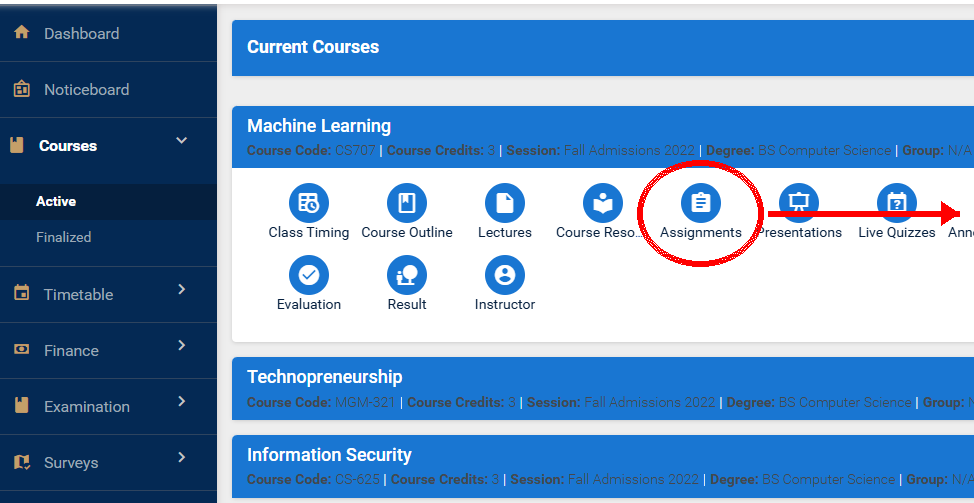
- Log in to your KIU LMS account.
- Go to My Courses.
- Pick the course the assignment belongs to.
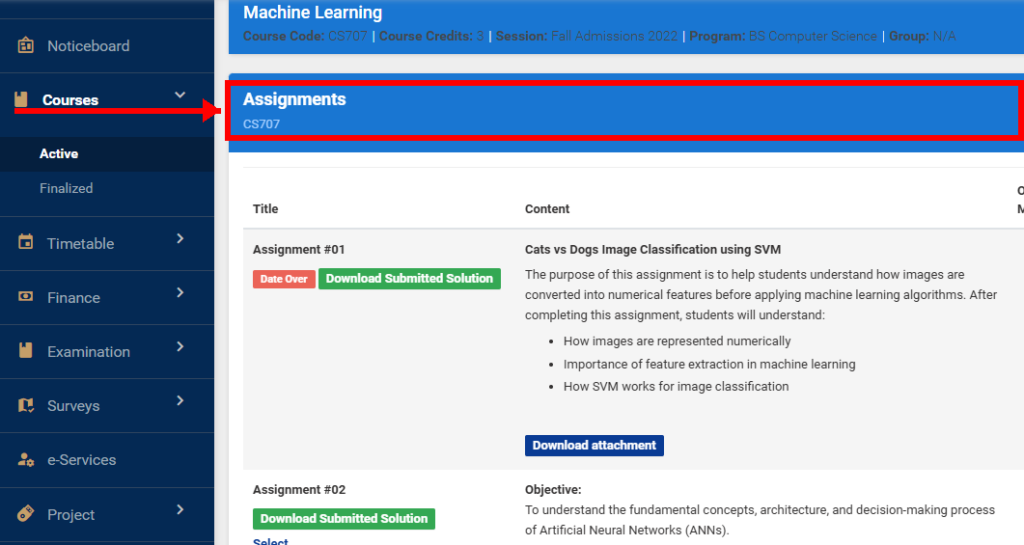
- Find the assignment under that course’s activities.
- Click on it to open it.
- Read through the instructions before doing anything else.
- Click Add Submission (or Upload Assignment).
- Select the file from your device.
- Let it finish uploading.
- Click Submit (or Save Changes).
- Confirm if it asks you to.
Once that’s done, you should see a confirmation message telling you the submission went through.
Before you hit submit, take thirty seconds to double-check:
- The file name actually makes sense
- The document is finished, not a half-written draft
- You picked the right file (not last week’s homework)
- It’s under whatever size limit the LMS allows
- It opens properly when you check it
And honestly — submit a day or two early if you can. It’s not about being an overachiever, it’s just insurance against a slow connection or the server acting up right when you need it not to.
Checking That Your Submission Actually Went Through
Don’t just assume it worked — check. The LMS usually shows you:
- Submission status
- Date and time submitted
- File name
- Instructor feedback (once it’s posted)
- Your grade (after it’s been marked)
If it still says “Draft” or “Not Submitted,” that means it didn’t actually go through — fix that right away, don’t wait.
Also, always keep a copy of your own assignment somewhere — your laptop, Google Drive, wherever. If something ever goes wrong on the LMS side, you’ll want proof of what you turned in.
Editing a Submission After the Fact
Some instructors let you swap out your file before the deadline hits. If that’s allowed:
- Open the assignment.
- Click Edit Submission.
- Remove the old file if needed.
- Upload the new one.
- Save.
- Confirm the new version is what’s recorded.
Once the deadline passes, though, most courses lock this down — so it’s worth giving your work one last read before you submit it the first time.
How to Download Course Materials From KIU LMS 2026 | Student Guide
The LMS is basically your library for the semester — lecture notes, slides, readings, everything. You don’t need to be sitting in class to get to any of it, which makes it a lot easier to prep for a quiz or catch up on something you didn’t fully understand the first time.
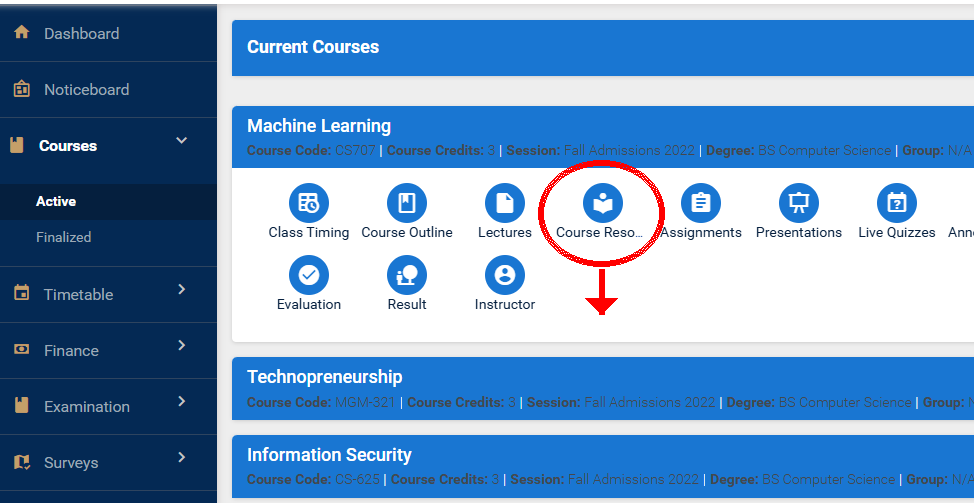
Materials you’ll typically find:
- Lecture notes
- PowerPoint slides
- PDF books
- Assigned readings
- Case studies
- Research articles
- Lab manuals
- Video lectures
- Course outlines
One tip that saves a lot of headaches later: download things as they’re posted instead of scrambling right before exams, especially if your internet isn’t always reliable.
Lecture Notes On KIU LMS
These are usually the most useful thing on the platform. Instructors typically post:
- Weekly slides
- Class presentations
- Topic summaries
- Practice exercises
- Revision notes
Get in the habit of downloading them right after class and dropping them into a folder for that subject. It sounds small, but it makes revision so much less painful later.
PDFs On KIU LMS
A lot of course material comes as PDFs, mainly because they keep their formatting no matter what device you open them on. You’ll commonly see:
- Textbook chapters
- Course handbooks
- Journal articles
- Research papers
- Assignment briefs
- Study guides
Save these offline. It means you can study on a bus, during a power cut, wherever — no internet required.
Videos On KIU LMS
Recorded lectures have basically become standard now. Depending on the course, you might find:
- Full recorded lectures
- Demonstrations
- Lab tutorials
- Guest lectures
- Practical sessions
- Presentation recordings
Rewatching a confusing lecture usually does more for understanding than re-reading notes once. And if you missed a live session entirely, this is how you catch up — no need to email anyone asking what you missed.
How to Attend Online Classes
Virtual classes are one of the LMS’s core jobs — they let you keep up with your degree regardless of where you physically are. Log in a few minutes early if you can; instructors often share quick instructions right at the start that you don’t want to miss.
A decent internet connection, a working mic, and headphones go a long way toward making the whole experience less frustrating.
Zoom Classes On KIU LMS
A lot of instructors run lectures over Zoom. You’ll usually find, right on the LMS:
- The meeting link
- Meeting ID
- Password
- Class schedule
- Recordings of past sessions
A few things worth doing before you join:
- Make sure Zoom is updated.
- Check your connection beforehand.
- Join five or ten minutes early.
- Keep your mic muted unless you’re speaking.
- Stay respectful during discussions.
Also — use your actual name when joining. Makes it a lot easier for the instructor to know who’s actually present.
Google Meet On KIU LMS
Some instructors go with Google Meet instead. The LMS will give you:
- The meeting link
- Class timing
- Instructions for joining
- Attendance rules
Just click the link and join with your university email. Since it runs in the browser, there’s nothing extra to install, which some people prefer.
Live Sessions LMS
This is where the actual back-and-forth happens — you can ask questions, join discussions, share your screen, work with classmates, and get feedback in real time. Showing up consistently helps you understand the material better, and in a lot of courses it also factors into your participation or attendance marks.
How to Check Your Results on KIU LMS 2026
No more waiting around for printed result sheets — grades show up on the LMS as soon as instructors post them. Checking regularly means you find out early if something needs work, while there’s still time to actually do something about it.
Viewing Grades
- Log in.
- Open the course.
- Go to Grades.
- Look through your marks for:
- Assignments
- Quizzes
- Midterms
- Participation
- Practical work
- Finals
Plenty of instructors leave written comments alongside the numbers — actually read those. They usually explain exactly why you got the mark you did, which is more useful than the number itself.
Downloading Results
Some courses let you download a grade report. That can come in handy for:
- Keeping your own records
- Scholarship applications
- Academic advising meetings
- Tracking your own progress
- Conversations with parents
Just keep in mind: whatever shows on the LMS is unofficial. The university’s official transcript is the one that actually counts, and there can be small differences.
GPA
Some LMS setups show your GPA directly; others just give you individual course grades and leave the math to you. Either way, you can usually track:
- Course percentage
- Credit hours
- Grade points
- How the semester’s shaping up overall
Understanding how your GPA is actually calculated makes it a lot easier to set realistic goals instead of guessing.
Common KIU LMS Login Problems
The system’s generally solid, but login issues do pop up now and then. Most of them take two minutes to fix once you know what’s going on.
Wrong Username
Usually just a typo. Common culprits:
- A mistyped registration number
- An extra space
- Wrong capitalization
Before trying again, just double-check your ID against your admission documents.
Wrong Password
Passwords are case-sensitive, so one stray capital letter can lock you out. If it keeps failing:
- Re-type it slowly and carefully.
- Check if Caps Lock is on.
- Try a password reset.
- Contact the LMS administrator if nothing works.
A password manager can save you this whole headache going forward.
Server Problems
Sometimes it’s genuinely not you. Servers go down or slow up because of:
- Scheduled maintenance
- Heavy traffic (everyone logging in right before a deadline, for instance)
- System upgrades
- Plain technical faults
If this happens, just wait a bit and try again later. The university usually gives a heads-up before planned maintenance.
Browser Issues
An old, outdated browser can quietly break LMS features without any clear error message. Try:
- Updating your browser
- Clearing the cache
- Clearing cookies
- Turning off extensions you don’t need
- Switching browsers entirely if the problem persists
Chrome, Edge, Firefox, and Safari (kept up to date) tend to work best with the LMS.
Getting the Most Out of KIU LMS
A little routine goes a long way here. None of this is complicated — it’s just consistency.
Turn On Notifications
Enable browser or email alerts for:
- Assignment deadlines
- New announcements
- Quizzes opening up
- Grade updates
- Messages from instructors
This way you’re not manually refreshing the LMS every day just to check if something changed.
Don’t Wait Until the Last Minute
Submitting early isn’t just about avoiding penalties — it also:
- Sidesteps internet issues right when you need reliability most
- Cuts down on stress
- Leaves room to fix something if you notice a mistake
- Basically guarantees the upload actually goes through
Grab Notes as Soon as They’re Posted
Don’t wait until exam week to start downloading everything. Getting materials early means:
- You can study offline
- Revision goes faster
- Everything stays organized instead of scattered
- You’re less dependent on having a good connection later
- Exam prep feels less last-minute
Setting up a folder per course, right from week one, makes all of this almost automatic.
Put these habits together and the LMS stops being something you fight with — it just becomes the background system that keeps your semester running smoothly.
Benefits of KIU LMS 2026
Once you actually start using it, it’s easy to see why the LMS has changed how students and instructors work together. It pulls everything into one place, which makes studying feel a lot less scattered — whether you’re on campus every day or learning remotely, you can stay on top of your courses without needing to physically be anywhere.
It also cuts down on paperwork and makes communication between students and faculty a lot faster. At this point, using an LMS isn’t really optional for a modern university — it’s just how things run.
Here’s what actually makes it worth using.
1. You Can Learn From Anywhere
Probably the single biggest perk. As long as you’ve got internet, you can log in from a laptop, tablet, or phone — no need to be sitting in a classroom.
Add some images with alt attributes that include the keyphrase or synonyms
This matters a lot for:
- Distance learning students
- Students in remote areas
- People juggling work and studies
- Anyone who’s sick and missing class
- Students revising from home before exams
Basically, your schedule stops being tied to a physical building.
2. Everything You Need Is In One Place
Instead of lugging around textbooks and loose notes, it’s all sitting on the LMS:
- Lecture slides
- PDF notes
- Course outlines
- Recorded lectures
- Research articles
- Assignment briefs
- Practice exercises
- Reading material
Which just makes studying less of a scavenger hunt.
3. Communication Actually Gets Easier
Instructors can push out announcements, assignment instructions, exam schedules, resources, grades, and feedback the moment they’re ready — no waiting for the next class to hear about it.
And it goes both ways: students can ask questions, join discussion forums, and reach instructors without needing to physically track them down on campus.
4. Time Management Gets a Lot Simpler
With deadlines, quizzes, and class times all sitting right there on your dashboard, planning your week gets a lot easier. The calendar and notification reminders do a good chunk of the mental work for you, so fewer things slip through the cracks.
5. Submitting Assignments Is Actually Secure
Paper submissions always carry some risk — lost pages, mix-ups, no proof of when you handed something in. Uploading through the LMS avoids all of that. Every submission comes with:
- A timestamp
- Confirmation it was received
- Secure storage
- Instructor access to review it
Which means there’s a clear record for both sides if a question ever comes up.
6. Feedback and Grading Come Faster
Instructors mark work directly in the system, so you’re not waiting around indefinitely. You get:
- Marks
- Written comments
- Suggestions on what to improve
- Quiz results
- Exam grades
Getting feedback while it’s still relevant — not weeks later — actually helps you improve as the semester goes, not just after it’s over.
7. Less Paper, Less Waste
Since most material lives online, there’s a lot less printing happening overall — which is easier on your wallet and, honestly, better for the environment too.
Using KIU LMS on Mobile
A lot of students would rather check things on their phone than boot up a laptop, and the good news is the LMS works fine across Android, iPhone, and regular mobile browsers. You don’t lose much by using your phone instead of a computer.
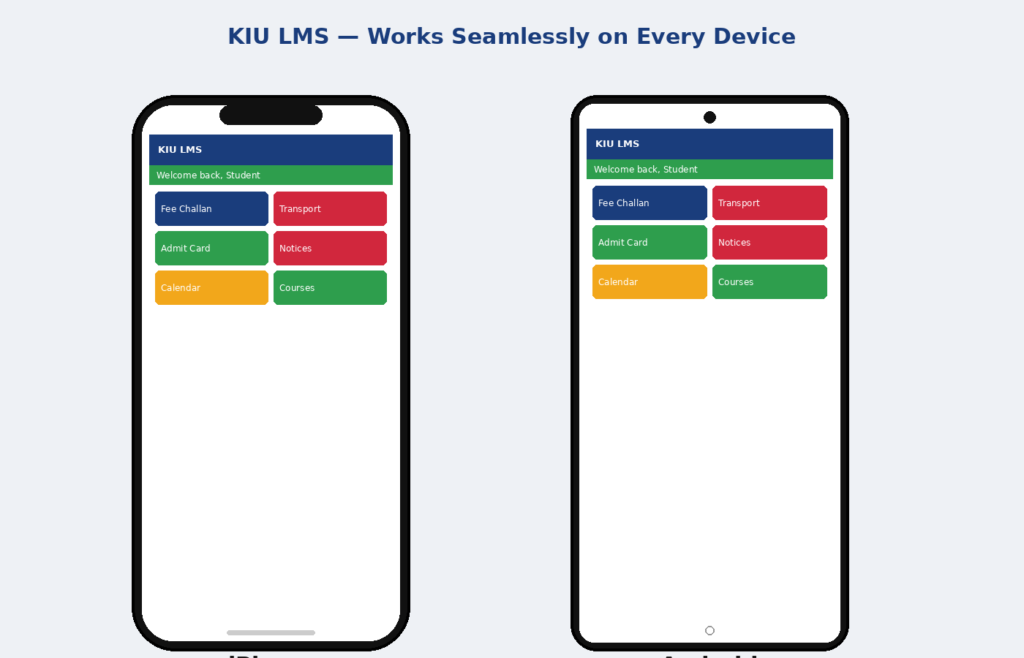
Android
On Android, you can get in through:
- Chrome
- Firefox
- Edge
- The LMS app, if the university has one
From there you can log in, view materials, submit assignments, download notes, join classes, take quizzes, check grades, and read announcements — pretty much everything, just on a smaller screen.
One tip: keep your browser and OS updated, since older versions sometimes cause weird glitches.
iPhone
iPhone and iPad users are covered too — Safari and most modern browsers work fine with the platform.
From an iPhone you can attend live classes, check announcements, submit coursework, download PDFs, watch recordings, view grades, and get notifications.
A stable Wi-Fi or data connection makes a noticeable difference here, especially during live sessions.
Using a Browser on a Laptop or Desktop
Plenty of students still prefer a bigger screen for actual studying, and the LMS runs smoothly on Chrome, Firefox, Edge, and Safari.
A few small things that help performance:
- Clear your cache every so often.
- Make sure JavaScript is enabled.
- Keep your browser updated.
- Use a stable connection.
- Don’t have twenty tabs open during a live class — it slows things down more than you’d think.
Departments Using KIU LMS
The LMS isn’t tied to one faculty — it’s used pretty broadly across the university, even though the exact courses available shift each semester. Departments that typically rely on it include:
- Computer Science
- Management Sciences
- Education
- Economics
- English
- Mathematics
- Environmental Sciences
- Biological Sciences
- Chemistry
- Physics
- Earth Sciences
- Tourism and Hospitality
- Media and Communication Studies
- International Relations
- Public Administration
- Commerce
- Law
- Agriculture
- Statistics
- Psychology
No matter which department you’re in, the experience is basically the same — course content, assignments, quizzes, grades, and instructor communication all work the same way.
LMS Rules Students Should Actually Follow
None of these are complicated, but they matter for keeping things fair and secure for everyone using the platform:
- Only use your own account — don’t log in as someone else.
- Never hand out your username or password, even to a friend.
- Submit your own original work — plagiarism is taken seriously.
- Hit assignment and quiz deadlines.
- Follow whatever instructions your instructor gives.
- Show up for online classes consistently.
- Keep communication respectful, with teachers and classmates alike.
- Don’t misuse forums or messaging for anything off-topic or inappropriate.
- Keep your personal details current.
- Log out if you’re on a shared or public computer.
- Report technical problems to the LMS administrator instead of just giving up.
Sticking to these keeps the whole system running smoothly — and keeps you out of avoidable trouble.
Final Thoughts
At this point, the KIU LMS 2026 | Student Guide is just part of how university works — course management, assignments, live classes, quizzes, grades, and communication all sitting in one platform instead of scattered across emails and paper.
It also gives you room to study independently — pulling up notes whenever you actually need them, not just when you’re sitting in a lecture hall. Whether that’s downloading materials, joining a live session, checking your results, or getting an assignment in before the deadline, most of it can be done without setting foot on campus.
If you want to actually get value out of it, the habits are simple: log in regularly, pay attention to notifications, take part in discussions instead of just lurking, keep your files organized, and stay ahead of course updates. Small things — a strong password, an updated browser, submitting work a little early — add up to a much smoother semester.
Learning is only going to keep moving in this direction, and platforms like the KIU LMS are a big part of what makes that shift workable. Once you’re comfortable with how it works, it stops being an extra task and just becomes part of how you get through the semester at Karakoram International University.
FAQs
It’s Karakoram International University’s official Learning Management System — the platform where students and instructors handle course material, assignments, virtual classes, quizzes, announcements, and grades, all in one place.
Go to the official KIU LMS site, enter your username or registration number, type your password, and click Login.
Look for the “Forgot Password” option, follow the recovery steps, and reset it using your registered email. If that doesn’t work, reach out to your department or the LMS administrator directly.
Yes — it works on Android, iPhone, tablets, and mobile browsers.